
Thomas Griffin 1/4/26
Join Our Email List
Get new content delivered directly to your inbox.
The Empty Tomb Project is a non-profit organization – 501(c)(3) – please support our mission by making a tax-deductible donation. DONATE HERE online or find out how to mail us your donation.

In 1865 William Dix published the now famous Christmas hymn, “What Child is This.” The lyrics of this song are worth pondering and deeply reflecting on for us during the celebration of the Christmas season in general and the feast of the Epiphany in particular.
Let’s prayerfully consider each of the three stanzas of this holy hymn.
What Child is this who, laid to rest,
On Mary’s lap is sleeping?
Whom angels greet with anthems sweet,
While shepherds watch are keeping?
This, this is Christ the King,
Whom shepherds guard and angels sing;
Haste, haste to bring Him laud,
The Babe, the Son of Mary.
The gentleness and simplicity of that moment when Jesus was born and placed in the lap of his mother is overwhelming in these lines. The shepherds appear and Mary is simply taking care of her son. In the intimacy of the moment, we are taught to pursue one-on-one time with the God-child as well. He seeks to be as close to us as he was to Mary in the stable.
Here we can also learn from the shepherds who teach us to guard our faith. The songwriter takes the theme of night watch (where they would protect their sheep from robbers and wolves) and applies it to their protective presence with the Holy Family. Our relationship with Christ must be protected like the shepherds would protect their flock. Otherwise, we risk losing it to our own laziness or to the temptations of the outside world.
The song continues:
Why lies He in such mean estate,
Where ox and ass are feeding?
Good Christians, fear, for sinners here
The silent Word is pleading.
Nails, spear shall pierce Him through,
The cross be borne for me, for you;
Hail, hail the Word made flesh,
The Babe, the Son of Mary.
These lines remind us that the shadow of the cross is cast on that holy manger on that silent night. It is a place of feeding. Christ’s body would one day become the spiritual food for the world in the Eucharist. This same Jesus pleads with us to draw close to the crib of the altar so we can catch a glimpse of the love that was willing to die for us.
This baby was born so that he might die for you and for me.
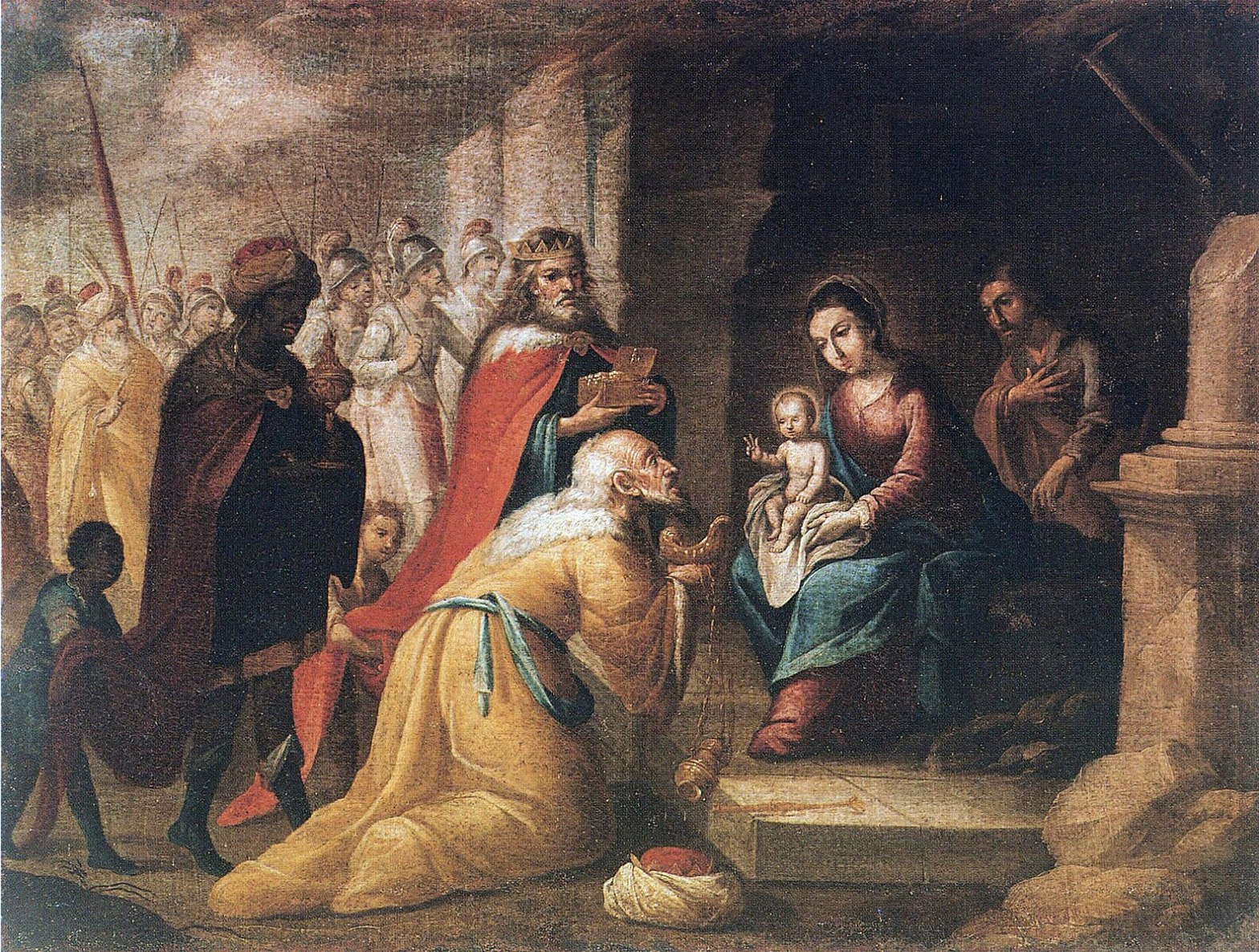
The final stanza concludes in this way, evoking the visit of the magi:
So bring Him incense, gold, and myrrh,
Come peasant, king to own Him;
The King of kings salvation brings,
Let loving hearts enthrone Him.
Raise, raise a song on high,
The virgin sings her lullaby;
Joy, joy for Christ is born,
The Babe, the Son of Mary.
These royal, intelligent and wealthy men visit and join the poverty of Mary, Joseph and the shepherds. They bring gifts for worship (frankincense), kingship (gold), and to foreshadow his death (myrrh). This child is to be adored because he is God. He is to be venerated because he will save us from our sins.
As his mother sings to him all we can do is rejoice because our God entered into the mess of our lives to pull us out of it, and bring us to live with Him forever – that is who this child is.
Thomas Griffin is the chairperson of the religion department at a Catholic high school on Long Island where he lives with his wife and children. He has a masters degree in theology and is a masters candidate in philosophy. Thomas is the Founder and Editor-in-Chief of Empty Tomb Project: The Magazine. He is the author of Let Us Begin: Saint Francis’s Way of Becoming Like Christ and Renewing the World.
Join Our Email List
Get new content delivered directly to your inbox.
 Empty Tomb Project