
Thomas Griffin 5/6/25
Join Our Email List
Get new content delivered directly to your inbox.
The Empty Tomb Project is a non-profit organization – 501(c)(3) – please support our mission by making a tax-deductible donation. DONATE HERE

Read “Empty Tomb Project: The Magazine”
Let Us Begin: New Book on the Life and Power of St. Francis
Today is the last day before the conclave begins, when we definitively begin to move beyond Francis.
The death of a pope is a huge deal.
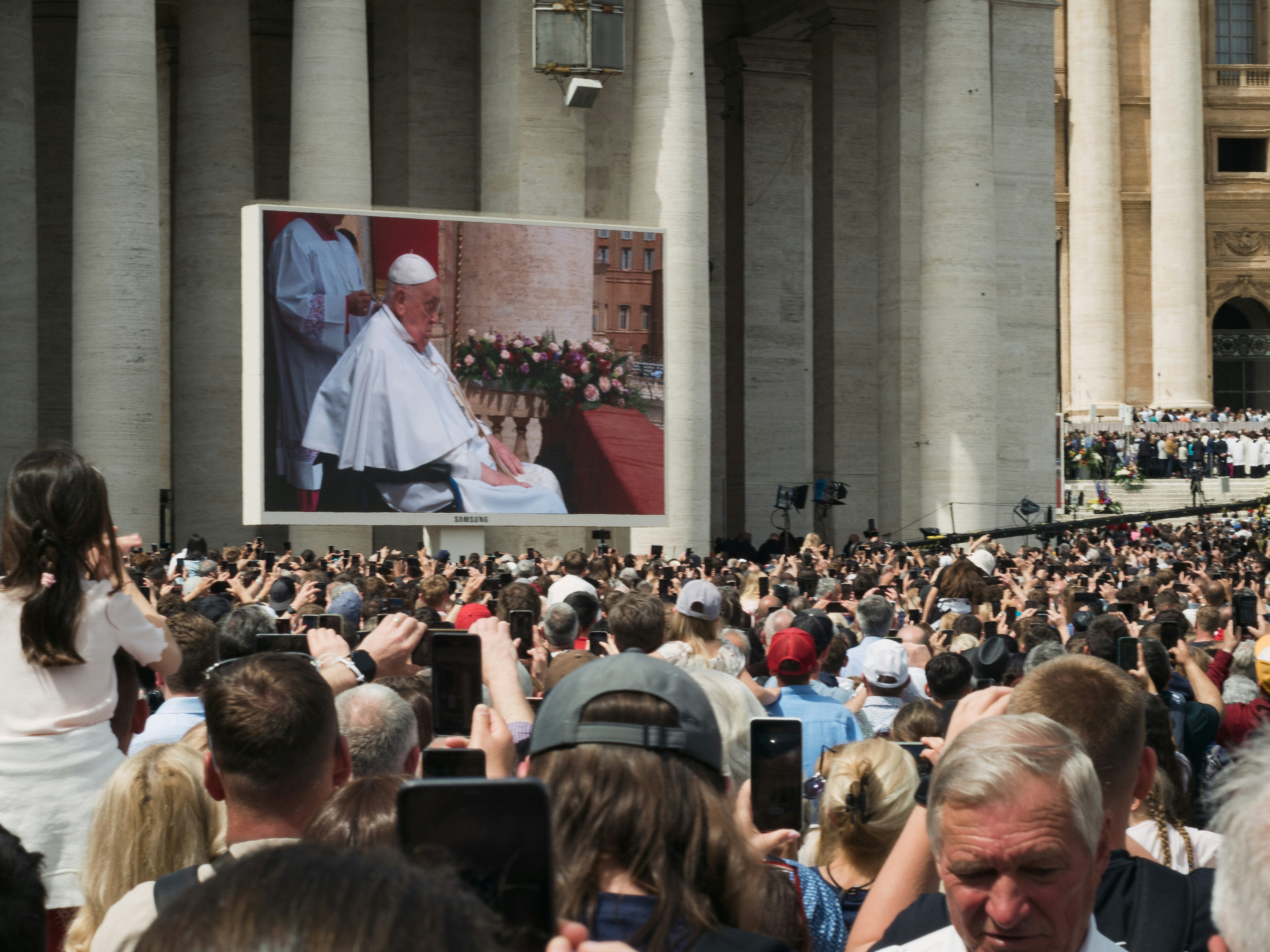
Pope Francis passed away on Easter Monday morning. After a long battle of illness, he died serving as pope until the end. Since his death there has been a whirlwind of articles and prose composed, attempting to summarize the pontiff. There is so much that can be said about this humble and simple servant of Christ.
He undoubtedly focused on mercy and mission. He was most concerned with ensuring that the world knew that it was loved, cared for and sought out by God. Francis was known to be driven in a small fiat rather than a fancy limousine. He wore the same black shoes as the pope that he did as bishop and priest in Argentina. He also chose to live in the more humble quarters of the Vatican rather than in the Papal Suites.
We must also note that many Catholics had several moments of unease due to the pope’s ambiguous remarks. Often, during interviews, Francis would speak freely and unscripted about the state of the Catholic Church as well as provide commentary on topics that are impacting the real world like marriage, liturgy and gender. His words were often the cause of much confusion.
This is not opinion, but fact.
Whether we agreed with him or not, he was the pope and he had the ability to speak in this way. To neglect to reference the ambiguity of Francis would be inaccurate and, I think, a disservice to the pope. He clearly desired to speak in a way that would cause more conversations on these topics. In most cases, his mission in this endeavor was accomplished.
No matter one’s opinion about his off-the-cuff remarks, Francis was clearly devoted to living a life of prayer and simplicity. There is so much we can learn from him. His twelve year pontificate included a plethora of important texts and words that inspired deeper faith. His writings and homilies will be digested for years to come. There is no doubt that investigating some of his most powerful words can aid us in realizing who God is and push us to become more like the men and women that Jesus is calling us to be.
Early on in his pontificate, in a 2013 interview, the pope said:
“I have a dogmatic certainty: God is in every person’s life. God is in everyone’s life. Even if the life of a person has been a disaster, even if it is destroyed by vices, drugs or anything else—God is in this person’s life. You can, you must try to seek God in every human life. Although the life of a person is a land full of thorns and weeds, there is always a space in which the good seed can grow. You have to trust God.”
These words clearly ame forth from the serious and intimate prayer life that Pope Francis led each day. As the successor of St. Peter, the pope relied on long periods of prayer to strengthen him and guide his decision-making. His knowledge of all that the Church was in need of gave him deeper insight into the heart of the Father. This gave him a vantage point for how God views his creation.
This can also be viewed in the words from his Apostolic Exhortation for the 150th Anniversary of Saint Therese of the Child Jesus. He said that “this insistence of Therese on God’s initiative leads her, when speaking of the Eucharist, to put first not her desire to receive Jesus in Holy Communion, but rather the desire of Jesus to unite himself to us and to dwell in our hearts” (#22).
It is critical for Catholics to speak to God about their own needs as well as to approach Him with reverence and awe. However, it is also necessary to contemplate the heart of God for His children. Before all else, God seeks us out, not the other way around. Knowing the needs of the People of God also emboldened the pope to speak frequently about the need to be on mission in proclaiming the power of Christ’s love and truth.
In his Apostolic Exhortation Evangelii Gaudium (The Joy of the Gospel), the pope wrote that “proclaiming Christ means showing that to believe in and to follow him is not only something right and true, but also something beautiful, capable of filling life with new splendour and profound joy, even in the midst of difficulties” (#129).
The pope affirmed the objective truth about Christ while pointing out that being a disciple is the result of knowing Jesus personally and encountering what he does to those who follow him. Christ makes us complete and reveals what it means to be fully alive. Life becomes more vibrant and meaningful when we give our entire selves to him because that makes us more like him. To be a man or woman of sacrifice is to be someone fully alive, even despite our flaws. Our sins, shortcomings and trials are not something to hide or run from. They are realities that Jesus desires to transform.
This truth is why Pope Francis famously called the church a “field hospital.” These words also come from a 2013 interview when he spoke about what the Catholic Church needs to be like today. He said: “The thing the church needs most today is the ability to heal wounds and to warm the hearts of the faithful; it needs nearness, proximity. I see the church as a field hospital after battle. It is useless to ask a seriously injured person if he has high cholesterol and about the level of his blood sugars! You have to heal his wounds. Then we can talk about everything else. Heal the wounds, heal the wounds.…And you have to start from the ground up.”
This is what Francis, above all else, will be remembered for. Through his actions, simplicity, words and witness one could feel his desire to communicate the need for humanity to be healed and know that God is near to them. All those, inside and outside of the pews, are hurting. We are all in need of being mended. Whether we are physically ill, emotionally drained, struggling to believe, or stuck in our sin – we need the risen Christ to make contact with our wounds.
Jesus left us his Spirit, his Real Presence, and his Catholic Church to do just that. May we trust that, just as Christ led the church through Pope Francis, that he will continue to do so through whoever is our next pope. He promised to do so two thousand years ago and until the end of the age.
Thomas Griffin is the chairperson of the religion department at a Catholic high school on Long Island where he lives with his wife and two sons. He has a masters degree in theology and is the Founder and Editor-in-Chief of Empty Tomb Project: The Magazine. He is the author of Let Us Begin: Saint Francis’s Way of Becoming Like Christ and Renewing the World.
Join Our Email List
Get new content delivered directly to your inbox.
 Empty Tomb Project