
Thomas Griffin 2/22/25
Join Our Email List
Get new content delivered directly to your inbox.
The Empty Tomb Project is a non-profit organization – 501(c)(3) – please support our mission by making a tax-deductible donation. DONATE HERE

Read “Empty Tomb Project: The Magazine”
Let Us Begin: New Book on the Life and Power of St. Francis
What separates the Catholic faith from every other religion is the fact that it is based on historical events. We base our belief in Jesus’ divinity on the eyewitness testimony of those who followed him along with the written testimony that references thousands of people being drawn into his teaching and being healed by him.
Among those close followers of eyewitnesses, Peter stands out among them all because of how Jesus selected him. The celebration of the Chair of Peter is meant to draw us into the historical fact of our faith and the inspirational truth that Jesus called Peter, and us, by name. Following the story of Peter, however, will also reveal to us that being a sinner does disqualify us from following Christ.
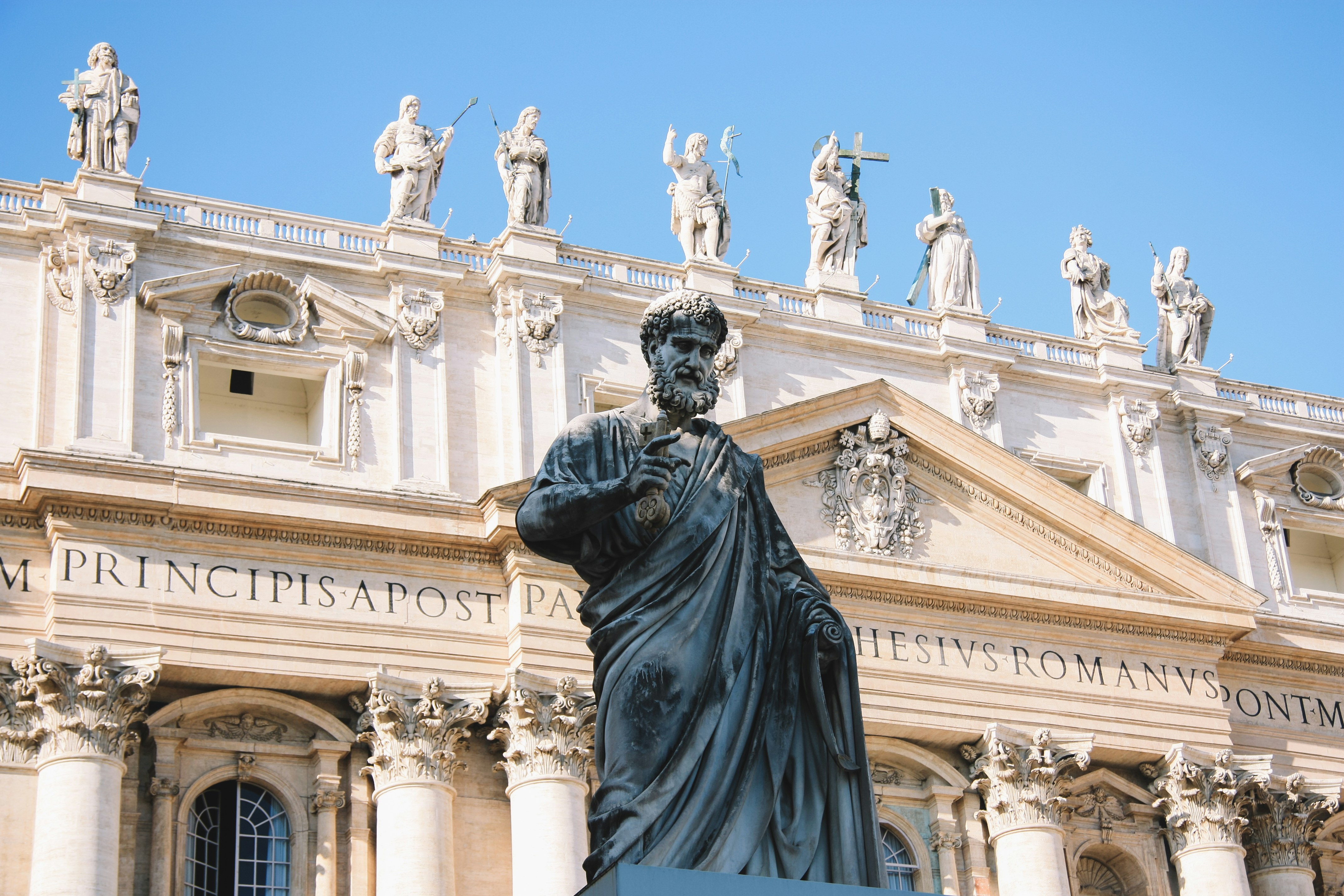
In the fourth century, Pope Sylvester and emperor Constantine built the original basilica over Saint Peter‘s tomb. In the 16 century that basilica was renovated to become the Saint Peter’s Basilica that we know today. From very early on in the history of the church, Peter played a key role.
The practice of showing reverence to the tombs of the martyrs was very prominent among the early church. Christians often faced persecutions, and they did not have large public spaces together for worship. Mass was celebrated in people’s homes or over the graves of the saints.
Special homage has been given to St. Peter’s tomb for many reasons.
First, we know that Jesus gave a special authority to Peter during his public ministry. This occurs at Caesarea Philippi when Jesus asked his disciples who people say that he is. Peter is the first one to state, “you are the Messiah, the Son of the living God” (Matthew 16:16).
It is at this moment that Jesus makes Peter the leader of the apostles. He tells him that he’s a rock upon which he will build his church, and he gives Peter the keys to the kingdom of heaven. The boldness that Peter shows reveals that he is the leader that the church will need.
Directly after these words, Jesus begins to tell his disciples that he will be arrested, handed over, suffer greatly, and be killed. Peter quickly dismisses these words of Jesus and tells him that he will not allow this to happen. Within a few minutes after being called the leader of the apostles, Jesus calls Peter his stumbling block or “Satan” (Matthew 16:23).
Here we see that Peter is going to be the leader, but that he’s also going to struggle in committing his entire life to Christ right away. The church is holy and founded by Jesus but it will be led by fallen men. This is visible in the last days of Jesus’ earthly journey as well.
When Jesus told Peter that he would deny him in his last days on earth, Christ also told him: “once you have turned back, you must strengthen your brothers” (Luke 22:32). Even with the knowledge that Peter would deny him, Jesus desired for Peter to both lead and embolden the early church. Christ knew that the human leaders of the church would be frail and broken in many ways. Even with this knowledge, Christ knew that it was better to have a flawed church than no church at all.
Finally, we can view Jesus’ wish to have Peter lead the church by becoming like his master. At the Sea of Tiberias, when Jesus appeared to Peter and the other disciples, he had some alone time with Peter. Here, Christ foretold that Peter would die like he did: “Amen, amen, I say to you, when you were younger, you used to dress yourself and go where you wanted; but when you grow old, you will stretch out your hands, and someone else will dress you and lead you where you do not want to go” (John 21:18).
Peter was called the leader of the apostles and the early church because Jesus desired him to be the visible representative of Christ when he was gone – to stand in his place. It is after the resurrection that Peter begins to finally live up to his calling. He even becomes like the one he is meant to represent in the way that he dies. Peter is crucified just like his master was, but Peter famously noted that he was not willing to die the same way. Jesus died. So he had the ex executioners crucify him upside down.
In the death of Peter, we see the value of celebrating the Chair of Peter – following after Jesus means that we reflect him and become like him. The more we know about the saints, the more we will be able to reflect Christ just like they did. So, no matter what flaws we might have, remember that Jesus calls us, despite the fact that we are sinners because he desires to make us into a mirror of him. That is what the Chair of Peter reminds us.
He is present with his broken church and he is present with broken humanity. Jesus never left.
Thomas Griffin is the chairperson of the religion department at a Catholic high school on Long Island where he lives with his wife and two sons. He has a masters degree in theology and is the Founder and Editor-in-Chief of Empty Tomb Project: The Magazine. He is the author of Let Us Begin: Saint Francis’s Way of Becoming Like Christ and Renewing the World.
Join Our Email List
Get new content delivered directly to your inbox.
 Empty Tomb Project