
Thomas Griffin 12/26/24
Join Our Email List
Get new content delivered directly to your inbox.
The Empty Tomb Project is a non-profit organization – 501(c)(3) – please support our mission by making a tax-deductible donation. DONATE HERE

Read “Empty Tomb Project: The Magazine”
Let Us Begin: New Book on the Life and Power of St. Francis
Click HERE for more information and a link to purchase.
St. Stephen’s feast day is celebrated on December 26th. The day before his commemoration we celebrate the fact that God became one of us. He entered the world as a small and vulnerable baby who was dependent on Mary and Joseph for everything. He came to save us from sin and death but He did so in a seemingly insignificant fashion.
The day after we celebrate the God-child, we remember the life of the first martyr – a man who was stoned to death. The scenes of the manger and feelings of the gentleness of the Incarnation quickly escalate into the murder of one of the earliest followers of Jesus. We quickly see that following after this babe born in Bethlehem is a matter of life or death. He is innocent and small, but he will require everything of us.
Learning what we can about Stephen will allow us to gain insight into what it means to allow Jesus to transform us while also giving us the challenge to follow after him with everything that we are.
We are told in the Acts of the Apostles that Stephen was a great preacher who was “filled with grace and power, was working great wonders and signs among the people” (Acts 6:8). It is clear that Stephen was a special man. When he spoke and acted, people listened and took notice because he knew Christ. Stephen’s daily prayer life and experience of Jesus Christ made him powerful because he was moved to act from the holiness of God rather than what people thought.
We can also gain from these words that Stephen was working some form of miracles. “Wonders and signs” are the same terms used for what Jesus accomplished during his ministry. Christ also told his followers: “Amen, amen, I say to you, whoever believes in me will do the works that I do, and will do greater ones than these, because I am going to the Father” (John 14:12). When one follows after Jesus, he turns that person into another Christ.
The entire point of the Incarnation is to save us because we cannot save ourselves. We are guilty of our sin, but God comes to set the score right Himself. Even though Jesus is the truly innocent one he takes on the weight of sin and crushes its power. We celebrate the beginning of this mission at Christmas. However, Christmas also communicates that God desires for us to be so united to Him that we become like Him.
This is why we celebrate Stephen on the first day after Christmas. Yes, because he is the first to give his life for Christ – but also because he shows us that we become like the one that we follow.
This is specifically seen in the details of Stepben’s trial and death. A Jewish group is bothered by his preaching so they bring claims to the Sanhedrin that Stephen was teaching blasphemy. Blasphemy is claiming to be God. This offense was punishable by death according to Jewish law. Blasphemy is also what the Jewish hierarchy brings against Jesus.
Stepehen, basing his teaching on the words of Jesus, was preaching that the Temple is no longer the place for true worship. The Temple prepared the foundation for what Jesus would bring. He would bring the ability for humanity to know God intimately. Fir this reason, Stephen reference the prophet Isaiah when he is on trial for his life:
‘The heavens are my throne, the earth is my footstool. What kind of house can you build for me? says the Lord, or what is to be my resting place? Did not my hand make all these things” (Isaiah 66).
All of the earth is the Lord’s. With the coming of Jesus we can know God and be united to Him in a powerful manner whenever we pray. With the institution of the Eucharist at the Last Supper, we cannot only know God intimately but He also comes so close to us that we can receive him.
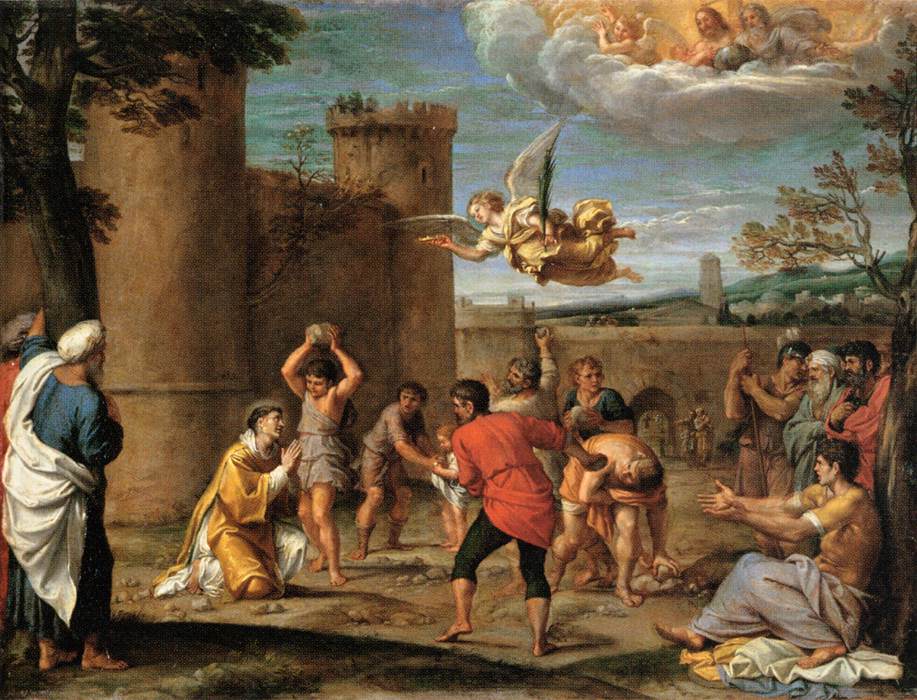
This talk of not needing the Temple cost Stephen his life, similar to Jesus. A man took the lead against Stephen, and began to stone him. Others joined in and his life was soon taken from him. Before he died, following Jesus even more closely, he spoke words that Jesus did before he died. Stephen gave over his life in complete abandonment: “Lord Jesus, receive my spirit” (Acts 7:59). This was similar to Christ’s words except for the fact that Jesus spoke them in reference to his Father. Stephen is clearly dying for Christ who he is claiming to be God. His address in his last moments on earth proclaims this.
Stephen’s willingness to endure such a slow and painful death is due to his heart’s conviction that Jesus is God. he knew Jesus. He had a relationship with the Risen Christ. He was not simply being strong in his belief – Stephen was acting out of love for a person he knew. The God-child who was born in Bethlehem was his savior and his friend.
Then the last words Stephen spoke on earth were, “Lord, do not hold this sin against them” (Acts 7:60). The forgiveness that Jesus spoke towards his persecutors (Luke 23:34) became Stephen’s own. The love Stephen had for Jesus spilled out towards others, even to those that hated him. In these last words of his life he reminds us again that the Christian life is meant to form us, like a potter who molds clay, into another Christ.
May our Christmas journey be rooted in this invitation, and may we live with the love that empowered Stephen to live like Jesus – the love that lays in the manger.
Thomas Griffin is the chairperson of the religion department at a Catholic high school on Long Island where he lives with his wife and two sons. He has a masters degree in theology and is the Founder and Editor-in-Chief of Empty Tomb Project: The Magazine. He is the author of Let Us Begin: Saint Francis’s Way of Becoming Like Christ and Renewing the World.
Join Our Email List
Get new content delivered directly to your inbox.
 Empty Tomb Project